Farsi    Arabic    English   
Prefaces: Engles 1885       Marx 1869         Chapters: I     II     III     IV     V     VI     VII    

The Eighteenth Brumaire of Louis Napoleon

Preface to the Second Edition (1869)


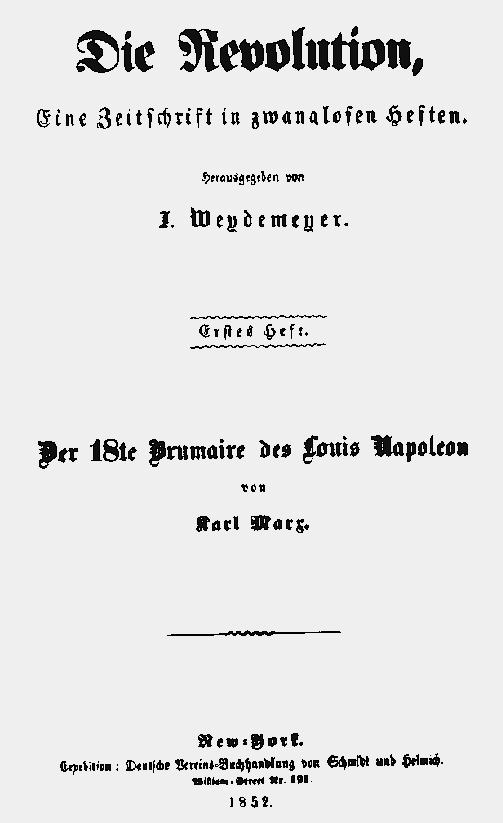
My friend Joseph Weydemeyer, whose death was so untimely, intended to publish a political weekly in New York starting from January 1, 1852. He invited me to provide this weekly with a history of the coup d'etat. Down to the middle of February, I accordingly wrote him weekly articles under the title The Eighteenth Brumaire of Louis Bonaparte. Meanwhile, Weydemeyer's original plan had fallen through. Instead, in the spring of I852 he began to publish a monthly, Die Revolution, whose first number consists of my Eighteenth Brumaire. A few hundred copies of this found their way into Germany at that time, without, however, getting into the actual book market. A German bookseller of extremely radical pretensions to whom I offered the sale of my book was most virtuously horrified at a "presumption" so "contrary to the times."

From the above facts it will be seen that the present work took shape under the immediate pressure of events and its historical material does not extend beyond the month of February, 1852. Its republication now is due in part to the demand of the book trade, in part to the urgent requests of my friends in Germany.

Of the writings dealing with the same subject at approximately the same time as mine, only two deserve notice: Victor Hugo's Napoleon le Petit and Proudhon's Coup d'Etat. Victor Hugo confines himself to bitter and witty invective against the responsible producer of the coup d'etat. The event itself appears in his work like a bolt from the blue. He sees in it only the violent act of a single individual. He does not notice that he makes this individual great instead of little by ascribing to him a personal power of initiative unparalleled in world history. Proudhon, for his part, seeks to represent the coup d'etat as the result of an antecedent historical development. Inadvertently, however, his historical construction of the coup d'etat becomes a historical apologia for its hero. Thus he falls into the error of our so-called objective historians. I, on the contrary, demonstrate how the class struggle in France created circumstances and relationships that made it possible for a grotesque mediocrity to play a hero's part.

A revision of the present work would have robbed it of its particular coloring. Accordingly, I have confined myself to mere correction of printer's errors and to striking out allusions now no longer intelligible.

The concluding words of my work: "But when the imperial mantle finally falls on the shoulders of Louis Bonaparte, the bronze statue of Napoleon will come crashing down from the top of the Vendome Column," have already been fulfilled. Colonel Charras opened the attack on the Napoleon cult in his work on the campaign of 1815. Subsequently, and especially in the past few years, French literature has made an end of the Napoleon legend with the weapons of historical research, criticism, satire, and wit. Outside France, this violent breach with the traditional popular belief, this tremendous mental revolution, has been little noticed and still less understood.

Lastly, I hope that my work will contribute toward eliminating the school-taught phrase now current, particularly in Germany, of so-called Caesarism. In this superficial historical analogy the main point is forgotten, namely, that in ancient Rome the class struggle took place only within a privileged minority, between the free rich and the free poor, while the great productive mass of the population, the slaves, formed the purely passive pedestal for these combatants. People forget Sismondi's significant saying: The Roman proletariat lived at the expense of society, while modern society lives at the expense of the proletariat. With so complete a difference between the material, economic conditions of the ancient and the modern class struggles, the political figures produced by them can likewise have no more in common with one another than the Archbishop of Canterbury has with the High Priest Samuel.


Karl Marx,
London, June 25, 1869

On December 2 1851, followers of President Louis Bonaparte (Napoleon's nephew) broke up the Legislative Assembly and established a dictatorship. A year later, Louis Bonaparte proclaimed himself Emperor Napoleon III.

Marx wrote The Eighteenth Brumaire of Louis Napoleon between December 1851 and February 1852. The "Eighteenth Brumaire" refers to November 9, 1799 in the French Revolutionary Calendar - the day the first Napoleon Bonaparte had made himself dictator by a coup d'etat.

In this work Marx traces how the conflict of different social interests manifest themselves in the complex web of political struggles, and in particular the contradictory relationships between the outer form of a struggle and its real social content. The proletariat of Paris was at this time too inexperienced to win power, but the experiences of 1848-51 would prove invaluable for the successful workers' revolution of 1871.

See Chapter 6 for a succinct time line of the period.

Prefaces: Engles 1885       Marx 1869         Chapters: I     II     III     IV     V     VI     VII    

The Eighteenth Brumaire of Louis Napoleon

I

February 1848 to December 1851


Hegel remarks somewhere[*] that all great world-historic facts and personages appear, so to speak, twice. He forgot to add: the first time as tragedy, the second time as farce. Caussidiere for Danton, Louis Blanc for Robespierre, the Montagne of 1848 to 1851 for the Montagne of 1793 to 1795, the nephew for the uncle. And the same caricature occurs in the circumstances of the second edition of the Eighteenth Brumaire.

Men make their own history, but they do not make it as they please; they do not make it under self-selected circumstances, but under circumstances existing already, given and transmitted from the past. The tradition of all dead generations weighs like a nightmare on the brains of the living. And just as they seem to be occupied with revolutionizing themselves and things, creating something that did not exist before, precisely in such epochs of revolutionary crisis they anxiously conjure up the spirits of the past to their service, borrowing from them names, battle slogans, and costumes in order to present this new scene in world history in time-honored disguise and borrowed language. Thus Luther put on the mask of the Apostle Paul, the Revolution of 1789-1814 draped itself alternately in the guise of the Roman Republic and the Roman Empire, and the Revolution of 1848 knew nothing better to do than to parody, now 1789, now the revolutionary tradition of 1793-95. In like manner, the beginner who has learned a new language always translates it back into his mother tongue, but he assimilates the spirit of the new language and expresses himself freely in it only when he moves in it without recalling the old and when he forgets his native tongue.

When we think about this conjuring up of the dead of world history, a salient difference reveals itself. Camille Desmoulins, Danton, Robespierre, St. Just, Napoleon, the heroes as well as the parties and the masses of the old French Revolution, performed the task of their time – that of unchaining and establishing modern bourgeois society – in Roman costumes and with Roman phrases. The first one destroyed the feudal foundation and cut off the feudal heads that had grown on it. The other created inside France the only conditions under which free competition could be developed, parceled-out land properly used, and the unfettered productive power of the nation employed; and beyond the French borders it swept away feudal institutions everywhere, to provide, as far as necessary, bourgeois society in France with an appropriate up-to-date environment on the European continent. Once the new social formation was established, the antediluvian colossi disappeared and with them also the resurrected Romanism – the Brutuses, the Gracchi, the publicolas, the tribunes, the senators, and Caesar himself. Bourgeois society in its sober reality bred its own true interpreters and spokesmen in the Says, Cousins, Royer-Collards, Benjamin Constants, and Guizots; its real military leaders sat behind the office desk and the hog-headed Louis XVIII was its political chief. Entirely absorbed in the production of wealth and in peaceful competitive struggle, it no longer remembered that the ghosts of the Roman period had watched over its cradle.

But unheroic though bourgeois society is, it nevertheless needed heroism, sacrifice, terror, civil war, and national wars to bring it into being. And in the austere classical traditions of the Roman Republic the bourgeois gladiators found the ideals and the art forms, the self-deceptions, that they needed to conceal from themselves the bourgeois-limited content of their struggles and to keep their passion on the high plane of great historic tragedy. Similarly, at another stage of development a century earlier, Cromwell and the English people had borrowed from the Old Testament the speech, emotions, and illusions for their bourgeois revolution. When the real goal had been achieved and the bourgeois transformation of English society had been accomplished, Locke supplanted Habakkuk.

Thus the awakening of the dead in those revolutions served the purpose of glorifying the new struggles, not of parodying the old; of magnifying the given task in the imagination, not recoiling from its solution in reality; of finding once more the spirit of revolution, not making its ghost walk again.

From 1848 to 1851, only the ghost of the old revolution circulated - from Marrast, the républicain en gants jaunes [Republican in yellow gloves], who disguised himself as old Bailly, down to the adventurer who hides his trivial and repulsive features behind the iron death mask of Napoleon. A whole nation, which thought it had acquired an accelerated power of motion by means of a revolution, suddenly finds itself set back into a defunct epoch, and to remove any doubt about the relapse, the old dates arise again – the old chronology, the old names, the old edicts, which had long since become a subject of antiquarian scholarship, and the old minions of the law who had seemed long dead. The nation feels like the mad Englishman in Bedlam[1] who thinks he is living in the time of the old Pharaohs and daily bewails the hard labor he must perform in the Ethiopian gold mines, immured in this subterranean prison, a pale lamp fastened to his head, the overseer of the slaves behind him with a long whip, and at the exits a confused welter of barbarian war slaves who understand neither the forced laborers nor each other, since they speak no common language. "And all this," sighs the mad Englishman, "is expected of me, a freeborn Briton, in order to make gold for the Pharaohs." "In order to pay the debts of the Bonaparte family," sighs the French nation. The Englishman, so long as he was not in his right mind, could not get rid of his idée fixé of mining gold. The French, so long as they were engaged in revolution, could not get rid of the memory of Napoleon, as the election of December 10 [1848, when Lous Bonapart was elected President of the French Republic by plebiscite] was proved. They longed to return from the perils of revolution to the fleshpots of Egypt[2], and December 2, 1851 [The date of the coup d'état by Louis Bonaparte], was the answer. Now they have not only a caricature of the old Napoleon, but the old Napoleon himself, caricatured as he would have to be in the middle of the nineteenth century.

The social revolution of the nineteenth century cannot take its poetry from the past but only from the future. It cannot begin with itself before it has stripped away all superstition about the past. The former revolutions required recollections of past world history in order to smother their own content. The revolution of the nineteenth century must let the dead bury their dead in order to arrive at its own content. There the phrase went beyond the content – here the content goes beyond the phrase.

The February Revolution was a surprise attack, a seizing of the old society unaware, and the people proclaimed this unexpected stroke a deed of world importance, ushering in a new epoch. On December 2 the February Revolution is conjured away as a cardsharp's trick, and what seems overthrown is no longer the monarchy but the liberal concessions that had been wrung from it through centuries of struggle. Instead of society having conquered a new content for itself, it seems that the state has only returned to its oldest form, to a shamelessly simple rule by the sword and the monk's cowl. This is the answer to the coup de main [unexpected stroke] of February, 1848, given by the coup de téte [rash act] of December, 1851. Easy come, easy go. Meantime, the interval did not pass unused. During 1848-51 French society, by an abbreviated revolutionary method, caught up with the studies and experiences which in a regular, so to speak, textbook course of development would have preceded the February Revolution, if the latter were to be more than a mere ruffling of the surface. Society seems now to have retreated to behind its starting point; in truth, it has first to create for itself the revolutionary point of departure – the situation, the relations, the conditions under which alone modern revolution becomes serious.

Bourgeois revolutions, like those of the eighteenth century, storm more swiftly from success to success, their dramatic effects outdo each other, men and things seem set in sparkling diamonds, ecstasy is the order of the day – but they are short-lived, soon they have reached their zenith, and a long Katzenjammer [crapulence] takes hold of society before it learns to assimilate the results of its storm-and-stress period soberly. On the other hand, proletarian revolutions, like those of the nineteenth century, constantly criticize themselves, constantly interrupt themselves in their own course, return to the apparently accomplished, in order to begin anew; they deride with cruel thoroughness the half-measures, weaknesses, and paltriness of their first attempts, seem to throw down their opponents only so the latter may draw new strength from the earth and rise before them again more gigantic than ever, recoil constantly from the indefinite colossalness of their own goals – until a situation is created which makes all turning back impossible, and the conditions themselves call out:

Hic Rhodus, hic salta!
[Here is the rose, here dance!] [3]

For the rest, every fair observer, even if he had not followed the course of French developments step by step, must have had a presentiment of the imminence of an unheard-of disgrace for the revolution. It was enough to hear the complacent yelps of victory with which the democrats congratulated each other on the expectedly gracious consequences of the second Sunday in May, 1852. [day of elections – Louis Bonaparte's term was expired] In their minds that second Sunday of May had become a certain idea, a dogma, like the day of Christ's reappearance and the beginning of the millennium in the minds of the Chiliasts[4]. As always, weakness had taken refuge in a belief in miracles, believed the enemy to be overcome when he was only conjured away in imagination, and lost all understanding of the present in an inactive glorification of the future that was in store for it and the deeds it had in mind but did not want to carry out yet. Those heroes who seek to disprove their demonstrated incapacity – by offering each other their sympathy and getting together in a crowd – had tied up their bundles, collected their laurel wreaths in advance, and occupied themselves with discounting on the exchange market the republics in partibus [in partibus infidelium – in the lands of the infidels] for which they had already providently organized the government personnel with all the calm of their unassuming disposition. December 2 struck them like a thunderbolt from a clear sky, and those who in periods of petty depression gladly let their inner fears be drowned by the loudest renters will perhaps have convinced themselves that the times are past when the cackle of geese could save the Capitol[5].

The constitution, the National Assembly, the dynastic parties, the blue and red republicans, the heroes of Africa, the thunder from the platform, the sheet lightning of the daily press, the entire literature, the political names and the intellectual reputations, the civil law and the penal code, liberté, egalité, fraternité, and the second Sunday in May, 1852 – all have vanished like a phantasmagoria before the spell of a man whom even his enemies do not make out to be a sorcerer. Universal suffrage seems to have survived only for the moment, so that with its own hand it may make its last will and testament before the eyes of all the world and declare in the name of the people itself: "All that exists deserves to perish." [From Goethe's Faust, Part One.]

It is not enough to say, as the French do, that their nation was taken unawares. Nations and women are not forgiven the unguarded hour in which the first adventurer who came along could violate them. Such turns of speech do not solve the riddle but only formulate it differently. It remains to be explained how a nation of thirty-six millions can be surprised and delivered without resistance into captivity by three knights of industry.

Let us recapitulate in general outline the phases that the French Revolution went through from February 24, 1848, to December, 1851.

Three main periods are unmistakable: the February period; the period of the constitution of the republic or the Constituent National Assembly - May 1848 to May 28 1849; and the period of the constitutional republic or the Legislative National Assembly – May 28 1849 to December 2 1851.

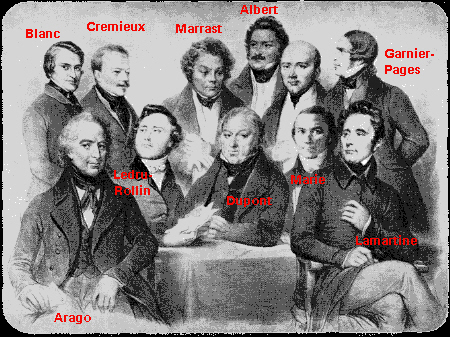
The first period – from February 24, the overthrow of Louis Philippe, to May 4, 1848, the meeting of the Constituent Assembly – the February period proper, may be designated as the prologue of the revolution. Its character was officially expressed in the fact that the government it improvised itself declared that it was provisional, and like the government, everything that was mentioned, attempted, or enunciated during this period proclaimed itself to be only provisional. Nobody and nothing ventured to lay any claim to the right of existence and of real action. All the elements that had prepared or determined the revolution – the dynastic opposition, the republican bourgeoisie, the democratic-republican petty bourgeoisie, and the social-democratic workers, provisionally found their place in the February government.

Louis Blanc Adolphe Crémieux Armand Marrast Albert L'Ouvrier Louis-Antoine Garnier-Pagès François Arago Alexandre Auguste Ledru-Rollin Jacques-Charles Dupont de l'Eure Pierre Marie (de Saint-Georges) Alphonse de Lamartine
The French Provisional Government of 1848

It could not be otherwise. The February days originally intended an electoral reform by which the circle of the politically privileged among the possessing class itself was to be widened and the exclusive domination of the aristocracy of finance overthrown. When it came to the actual conflict, however – when the people mounted the barricades, the National Guard maintained a passive attitude, the army offered no serious resistance, and the monarchy ran away – the republic appeared to be a matter of course. Every party construed it in its own way. Having secured it arms in hand, the proletariat impressed its stamp upon it and proclaimed it to be a social republic. There was thus indicated the general content of the modern revolution, a content which was in most singular contradiction to everything that, with the material available, with the degree of education attained by the masses, under the given circumstances and relations, could be immediately realized in practice. On the other hand, the claims of all the remaining elements that had collaborated in the February Revolution were recognized by the lion's share they obtained in the government. In no period, therefore, do we find a more confused mixture of high-flown phrases and actual uncertainty and clumsiness, of more enthusiastic striving for innovation and more deeply rooted domination of the old routine, of more apparent harmony of the whole of society; and more profound estrangement of its elements. While the Paris proletariat still reveled in the vision of the wide prospects that had opened before it and indulged in seriously meant discussions of social problems, the old powers of society had grouped themselves, assembled, reflected, and found unexpected support in the mass of the nation, the peasants and petty bourgeois, who all at once stormed onto the political stage after the barriers of the July Monarchy had fallen.

The second period, from May 4, 1848, to the end of May, 1849, is the period of the constitution, the foundation, of the bourgeois republic. Immediately after the February days not only had the dynastic opposition been surprised by the republicans and the republicans by the socialists, but all France by Paris. The National Assembly, which met on May 4, 1848, had emerged from the national elections and represented the nation. It was a living protest against the pretensions of the February days and was to reduce the results of the revolution to the bourgeois scale. In vain the Paris proletariat, which immediately grasped the character of this National Assembly, attempted on May 15, a few days after it met, to negate its existence forcibly, to dissolve it, to disintegrate again into its constituent parts the organic form in which the proletariat was threatened by the reacting spirit of the nation. As is known, May 15 had no other result but that of removing Blanqui and his comrades – that is, the real leaders of the proletarian party – from the public stage for the entire duration of the cycle we are considering.

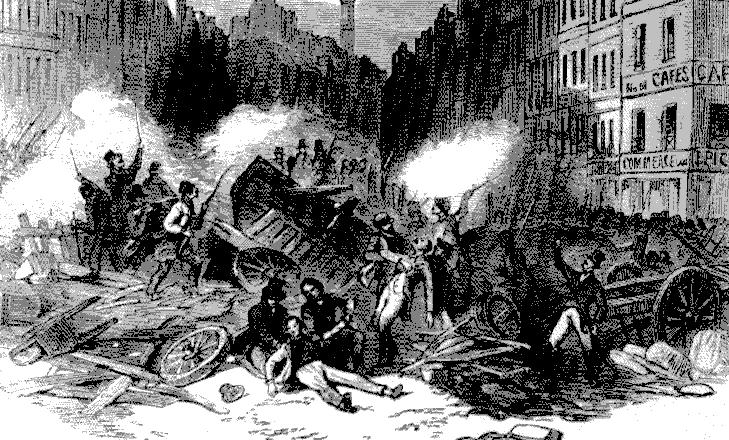
The bourgeois monarchy of Louis Philippe can be followed only by a bourgeois republic; that is to say, whereas a limited section of the bourgeoisie ruled in the name of the king, the whole of the bourgeoisie will now rule in the name of the people. The demands of the Paris proletariat are utopian nonsense, to which an end must be put. To this declaration of the Constituent National Assembly the Paris proletariat replied with the June insurrection, the most colossal event in the history of European civil wars. The bourgeois republic triumphed. On its side stood the aristocracy of finance, the industrial bourgeoisie, the middle class, the petty bourgeois, the army, the lumpen proletariat organized as the Mobile Guard, the intellectual lights, the clergy, and the rural population. On the side of the Paris proletariat stood none but itself. More than three thousand insurgents were butchered after the victory, and fifteen thousand were deported without trial. With this defeat the proletariat passes into the background on the revolutionary stage. It attempts to press forward again on every occasion, as soon as the movement appears to make a fresh start, but with ever decreased expenditure of strength and always slighter results. As soon as one of the social strata above it gets into revolutionary ferment, the proletariat enters into an alliance with it and so shares all the defeats that the different parties suffer, one after another. But these subsequent blows become the weaker, the greater the surface of society over which they are distributed. The more important leaders of the proletariat in the Assembly and in the press successively fall victim to the courts, and ever more equivocal figures come to head it. In part it throws itself into doctrinaire experiments, exchange banks and workers' associations, hence into a movement in which it renounces the revolutionizing of the old world by means of the latter's own great, combined resources, and seeks, rather, to achieve its salvation behind society's back, in private fashion, within its limited conditions of existence, and hence necessarily suffers shipwreck. It seems to be unable either to rediscover revolutionary greatness in itself or to win new energy from the connections newly entered into, until all classes with which it contended in June themselves lie prostrate beside it. But at least it succumbs with the honors of the great, world-historic struggle; not only France, but all Europe trembles at the June earthquake, while the ensuing defeats of the upper classes are so cheaply bought that they require barefaced exaggeration by the victorious party to be able to pass for events at all, and become the more ignominious the further the defeated party is removed from the proletarian party.

The defeat of the June insurgents, to be sure, had now prepared, had leveled the ground on which the bourgeois republic could be founded and built, but it had shown at the same time that in Europe the questions at issue are other than that of "republic or monarchy." It had revealed that here "bourgeois republic" signifies the unlimited despotism of one class over other classes. It had proved that in countries with an old civilization, with a developed formation of classes, with modern conditions of production, and with an intellectual consciousness in which all traditional ideas have been dissolved by the work of centuries, the republic signifies in general only the political form of revolution of bourgeois society and not its conservative form of life – as, for example, in the United States of North America, where, though classes already exist, they have not yet become fixed, but continually change and interchange their elements in constant flux, where the modern means of production, instead of coinciding with a stagnant surplus population, rather compensate for the relative deficiency of heads and hands, and where, finally, the feverish, youthful movement of material production, which has to make a new world of its own, has neither time nor opportunity left for abolishing the old world of ghosts.

During the June days all classes and parties had united in the party of Order against the proletarian class as the party of anarchy, of socialism, of communism. They had "saved" society from "the enemies of society." They had given out the watchwords of the old society, "property, family, religion, order," to their army as passwords and had proclaimed to the counterrevolutionary crusaders: "In this sign thou shalt conquer!" From that moment, as soon as one of the numerous parties which gathered under this sign against the June insurgents seeks to hold the revolutionary battlefield in its own class interest, it goes down before the cry: "property, family, religion, order." Society is saved just as often as the circle of its rulers contracts, as a more exclusive interest is maintained against a wider one. Every demand of the simplest bourgeois financial reform, of the most ordinary liberalism, of the most formal republicanism, of the most shallow democracy, is simultaneously castigated as an "attempt on society" and stigmatized as "socialism." And finally the high priests of "religion and order" themselves are driven with kicks from their Pythian tripods, hauled out of their beds in the darkness of night, put in prison vans, thrown into dungeons or sent into exile; their temple is razed to the ground, their mouths are sealed, their pens broken, their law torn to pieces in the name of religion, of property, of the family, of order. Bourgeois fanatics for order are shot down on their balconies by mobs of drunken soldiers, their domestic sanctuaries profaned, their houses bombarded for amusement – in the name of property, of the family, of religion, and of order. Finally, the scum of bourgeois society forms the holy phalanx of order and the hero Crapulinski installs himself in the Tuileries as the "savior of society."


Footnotes I

[1] Bedlam was an infamous lunatic asylum in England.

[2] The expression, "to sigh for the flesh-pots of Egypt" is taken from the biblical legend, according to which during the exodus of the Israelites from Egypt the faint-hearted among them wished that they had died when they sat by the flesh-pots of Egypt, rather than undergo their present trials through the desert.

[3] Hic Rhodus, hic salta.

The origin of this odd saying, whose currency is largely due to Hegel and Marx, takes a little explaining. Its original form is "Hic Rhodus, hic saltus" ("Rhodes is here, here is the place for your jump"), a traditional Latin translation [see, e.g., Erasmus, Adagia 3. 3. 28] of a punchline from Aesop. In the fable The Braggart an athlete boasts that he once performed a stupendous jump in Rhodes, and can produce witnesses: the punchline is the comment of a bystander, who means that there is no need of witnesses, since the athlete can demonstrate the jump here and now.

The epigram is given by Hegel, rather out of the blue, first in Greek, then in Latin (in the form "Hic Rhodus, hic saltus"), in the Preface to his Philosophy of Right. He does not explain what the proverb meant in its original context (without which it can hardly be understood); indeed a comment he makes about jumping over Rhodes suggests that he may not have fully understood it himself. At any rate, he then offers an adapted German version with a different meaning, "Hier ist die Rose, hier tanze" ("Here is the rose, dance here", an allusion to the rose in the cross of rosicrucianism, implying that fulfilment should not be postponed to some Utopian future), punning first on the Greek (Rhodos = Rhodes, rhodon = rose), then on the Latin (saltus = jump [noun], salta = dance [imperative]). Marx adopts the saying in the saying, first giving the Latin, in the form "Hic Rhodus, hic salta!", a garbled mixture of Hegel's two versions, and then immediately adds "Hier ist die Rose, hier tanze!", as if it were a translation, which it cannot be, since Greek Rhodos (despite what all the standard commentators say to the contrary), let alone Latin Rhodus, does not mean "rose". [From Isaiah Berlin Virtual Library]

[4] Chiliasts (from the Greek word chilias – a thousand): preachers of a mystical religious doctrine concerning the second coming of Christ and the estalishment of the millennium when justice, universal equality and prosperity would be triumphant.

[5] Capitol: A hill in Rome, a fortified citadel where the temples of Jupiter, Juno and other gods were built. According to a legend, Rome was saved in 390 B.C.E. from an invasion of the Gauls, due to the cackling of geese from Juno's temple which awakened the sleeping guards of the Capitol.

Prefaces: Engles 1885       Marx 1869         Chapters: I     II     III     IV     V     VI     VII    

The Eighteenth Brumaire of Louis Napoleon

II

Downfall of the Republicans


Let us pick up the threads of the development once more.

The history of the Constituent National Assembly since the June days is the history of the domination and the disintegration of the republican faction of the bourgeoisie, of the faction known by the names of tricolor republicans, pure republicans, political republicans, formalist republicans, etc.

Under the bourgeois monarchy of Louis Philippe it had formed the official republican opposition and consequently a recognized component part of the political world of the day. It had its representatives in the Chambers and a considerable sphere of influence in the press. Its Paris organ, the National, was considered just as respectable in its way as the Journal des Débats. Its character corresponded to this position under the constitutional monarchy. It was not a faction of the bourgeoisie held together by great common interests and marked off by specific conditions of production. It was a clique of republican-minded bourgeois, writers, lawyers, officers, and officials that owed its influence to the personal antipathies of the country to Louis Philippe, to memories of the old republic, to the republican faith of a number of enthusiasts, above all, however, to French nationalism, whose hatred of the Vienna treaties and of the alliance with England it stirred up perpetually. A large part of the following the National had under Louis Philippe was due to this concealed imperialism, which could consequently confront it later, under the republic, as a deadly rival in the person of Louis Bonaparte. It fought the aristocracy of finance, as did all the rest of the bourgeois opposition. Polemics against the budget, which in France were closely connected with fighting the aristocracy of finance, procured popularity too cheaply and material for puritanical leading articles too plentifully not to be exploited. The industrial bourgeoisie was grateful to it for its slavish defense of the French protectionist system, which it accepted, however, more on national grounds than on grounds of national economy; the bourgeoisie as a whole, for its vicious denunciation of communism and socialism. For the rest, the party of the National was purely republican; that is, it demanded a republican instead of a monarchist form of bourgeois rule and, above all, the lion's share of this rule. About the conditions of this transformation it was by no means clear in its own mind. On the other hand, what was clear as daylight to it, and was publicly acknowledged at the reform banquets in the last days of Louis Philippe, was its unpopularity with the democratic petty bourgeois, and in particular with the revolutionary proletariat. These pure republicans, as is indeed the way with pure republicans, were already at the point of contenting themselves in the first instance with a regency of the Duchess of Orleans when the February Revolution broke out and assigned their best-known representatives a place in the Provisional Government. From the start they naturally had the confidence of the bourgeoisie and a majority in the Constituent National Assembly. The socialist elements of the Provisional Government were excluded forthwith from the Executive Commission which the National Assembly formed when it met, and the party of the National took advantage of the outbreak of the June insurrection to discharge the Executive Commission also, and therewith to get rid of its closest rivals, the petty-bourgeois, or democratic, republicans (Ledru-Rollin, etc.). Cavaignac, the general of the bourgeois-republican part who commanded the June massacre, took the place of the Executive Commission with a sort of dictatorial power. Marrast, former editor in chief of the National, became the perpetual president of the Constituent National Assembly, and the ministries, as well as all other important posts, fell to the portion of the pure republicans.

The republican bourgeois faction, which had long regarded itself as the legitimate heir of the July Monarchy, thus found its fondest hopes exceeded; it attained power, however, not as it had dreamed under Louis Philippe, through a liberal revolt of the bourgeoisie against the throne, but through a rising of the proletariat against capital, a rising laid low with grapeshot. What it had conceived as the most revolutionary event turned out in reality to be the most counterrevolutionary. The fruit fell into its lap, but it fell from the tree of knowledge, not from the tree of life.

The exclusive rule of the bourgeois republicans lasted only from June 24 to December 10, 1848. It is summed up in the drafting of a republican constitution and in the state of siege of Paris.

The new constitution was at bottom only the republicanized edition of the constitutional Charter of 1830. The narrow electoral qualification of the July Monarchy, which excluded even a large part of the bourgeoisie from political rule, was incompatible with the existence of the bourgeois republic. In lieu of this qualification, the February Revolution had at once proclaimed direct universal suffrage. The bourgeois republicans could not undo this event. They had to content themselves with adding the limiting proviso of a six months' residence in the constituency. The old organization of the administration, the municipal system, the judicial system, the army, etc., continued to exist inviolate, or, where the constitution changed them, the change concerned the table of contents, not the contents; the name, not the subject matter.

The inevitable general staff of the liberties of 1848, personal liberty, liberty of the press, of speech, of association, of assembly, of education and religion, etc., received a constitutional uniform which made them invulnerable. For each of these liberties is proclaimed as the absolute right of the French citoyen, but always with the marginal note that it is unlimited so far as it is not limited by the "equal rights of others and the public safety" or by "laws" which are intended to mediate just this harmony of the individual liberties with one another and with the public safety. For example:

"The citizens have the right of association, of peaceful and unarmed assembly, of petition and of expressing their opinions, whether in the press or in any other way. The enjoyment of these rights has no limit save the equal rights of others and the public safety."

"Education is free. Freedom of education shall be enjoyed under the conditions fixed by law and under the supreme control of the state."

"The home of every citizen is inviolable except in the forms prescribed by law."

The constitution, therefore, constantly refers to future organic laws which are to put into affect those marginal notes and regulate the enjoyment of these unrestricted liberties in such manner that they will collide neither with one another nor with the public safety. And later these organic laws were brought into being by the friends of order and all those liberties regulated in such manner that the bourgeoisie in its enjoyment of them finds itself unhindered by the equal rights of the other classes. Where it forbids these liberties entirely to "the others," or permits enjoyment of them under conditions that are just so many police traps, this always happens solely in the interest of "public safety" – that is, the safety of the bourgeoisie – as the constitution prescribes. In the sequel, both sides accordingly appeal with complete justice to the constitution: the friends of order, who abrogated all these liberties, as well as the democrats, who demanded all of them. For each paragraph of the constitution contains its own antithesis, its own upper and lower house, namely, liberty in the general phrase, abrogation of liberty in the marginal note. Thus so long as the name of freedom was respected and only its actual realization prevented, of course in a legal way, the constitutional existence of liberty remained intact, inviolate, however mortal the blows dealt to its existence in actual life.

This constitution, made inviolable in so ingenious a manner, was nevertheless, like Achilles, vulnerable in one point – not in the heel, but in the head, or rather in the two heads it wound up with: the Legislative Assembly on the one hand, the President on the other. Glance through the constitution and you will find that only the paragraphs in which the relationship of the President to the Legislative Assembly is defined are absolute, positive, noncontradictory, and cannot be distorted. For here it was a question of the bourgeois republicans safeguarding themselves. Articles 45-70 of the Constitution are so worded that the National Assembly can remove the President constitutionally, whereas the President can remove the National Assembly only unconstitutionally, only by setting aside the constitution itself. Here, therefore, it challenges its forcible destruction. It not only sanctifies the division of powers, like the Charter of 1830, it widens it into an intolerable contradiction. The play of the constitutional powers, as Guizot termed the parliamentary squabble between the legislative and executive power, is in the constitution of 1848 continually played va-banque [staking all]. On one side are seven hundred and fifty representatives of the people, elected by universal suffrage and eligible for re-election; they form an uncontrollable, indissoluble, indivisible National Assembly, a National Assembly that enjoys legislative omnipotence, decides in the last instance on war, peace, and commercial treaties, alone possesses the right of amnesty, and, by its permanence, perpetually holds the front of the stage. On the other side is the President, with all the attributes of royal power, with authority to appoint and dismiss his ministers independently of the National Assembly, with all the resources of the executive power in his hands, bestowing all posts and disposing thereby in France of the livelihoods of at least a million and a half people, for so many depend on the five hundred thousand officials and officers of every rank. He has the whole of the armed forces behind him. He enjoys the privilege of pardoning individual criminals, of suspending National Guards, of discharging, with the concurrence of the Council of State, general, cantonal, and municipal councils elected by the citizens themselves. Initiative and direction are reserved to him in all treaties with foreign countries. While the Assembly constantly performs on the boards and is exposed to daily public criticism, he leads a secluded life in the Elysian Fields, and that with Article 45 of the constitution before his eyes and in his heart, crying to him daily: "Frere, il faut mourir!" [‘Brother, one must die!'] Your power ceases on the second Sunday of the lovely month of May in the fourth year after your election! Then your glory is at an end, the piece is not played twice, and if you have debts, look to it quickly that you pay them off with the 600,000 francs granted you by the constitution, unless, perchance, you prefer to go to Clichy on the second Monday of the lovely month of May! Thus, whereas the constitution assigns power to the President, it seeks to secure moral power for the National Assembly. Apart from the fact that it is impossible to create a moral power by paragraphs of law, the constitution here abrogates itself once more by having the President elected by all Frenchmen through direct suffrage. While the votes of France are split up among the seven hundred and fifty members of the National Assembly, they are here, on the contrary, concentrated on a single individual. While each separate representative of the people represents only this or that party, this or that town, this or that bridgehead, or even only the mere necessity of electing someone as the seven hundred and fiftieth, without examining too closely either the cause or the man, he is the elect of the nation and the act of his election is the trump that the sovereign people plays once every four years. The elected National Assembly stands in a metaphysical relation, but the elected President in a personal relation, to the nation. The National Assembly, indeed, exhibits in its individual representatives the manifold aspects of the national spirit, but in the President this national spirit finds its incarnation. As against the Assembly, he possesses a sort of divine right; he is President by the grace of the people.

Thetis, the sea goddess, prophesied to Achilles that he would die in the bloom of youth. The constitution, which, like Achilles, had its weak spot, also had, like Achilles, a presentiment that it must go to an early death. It was sufficient for the constitution-making pure republicans to cast a glance from the lofty heaven of their ideal republic at the profane world to perceive how the arrogance of the royalists, the Bonapartists, the democrats, the communists, as well as their own discredit, grew daily in the same measure as they approached the completion of their great legislative work of art, without Thetis on this account having to leave the sea and communicate the secret to them. They sought to cheat destiny by a catch in the constitution, through Article III according to which every motion for a revision of the constitution must be supported by at least three-quarters of the votes, cast in three successive debates with an entire month between each, with the added proviso that not less than five hundred members of the National Assembly must vote. Thereby they merely made the impotent attempt to continue exercising a power – when only a parliamentary minority, as which they already saw themselves prophetically in their mind's eye – a power which at that time, when they commanded a parliamentary majority and all the resources of governmental authority, was daily slipping more and more from their feeble hands.

Finally the constitution, in a melodramatic paragraph, entrusts itself "to the vigilance and the patriotism of the whole French people and every single Frenchman," after it has previously entrusted in another paragraph the "vigilant" and "patriotic" to the tender, most painstaking care of the High Court of Justice, the haute cour it invented for the purpose.

Such was the Constitution of 1848, which on December 2, 1851, was not overthrown by a head, but fell down at the touch of a mere hat; this hat, to be sure, was a three-cornered Napoleonic hat.

While the bourgeois republicans in the Assembly were busy devising, discussing, and voting this constitution, Cavaignac outside the Assembly maintained the state of siege of Paris. The state of siege of Paris was the midwife of the Constituent Assembly in its travail of republican creation. If the constitution is subsequently put out of existence by bayonets, it must not be forgotten that it was likewise by bayonets, and these turned against the people, that it had to be protected in its mother's womb and by bayonets that it had to be brought into existence. The forefathers of the "respectable republicans" had sent their symbol, the tricolor, on a tour around Europe. They themselves in turn produced an invention that of itself made its way over the whole Continent, but returned to France with ever renewed love until it has now become naturalized in half her departments – the state of siege. A splendid invention, periodically employed in every ensuing crisis in the course of the French Revolution. But barrack and bivouac, which were thus periodically laid on French society's head to compress its brain and render it quiet; saber and musket, which were periodically allowed to act as judges and administrators, as guardians and censors, to play policeman and do night watchman's duty; mustache and uniform, which were periodically trumpeted forth as the highest wisdom of society and as its rector - were not barrack and bivouac, saber and musket, mustache and uniform finally bound to hit upon the idea of instead saving society once and for all by proclaiming their own regime as the highest and freeing civil society completely from the trouble of governing itself? Barrack and bivouac, saber and musket, mustache and uniform were bound to hit upon this idea all the more as they might then also expect better cash payment for their higher services, whereas from the merely periodic state of siege and the transient rescues of society at the bidding of this or that bourgeois faction, little of substance was gleaned save some killed and wounded and some friendly bourgeois grimaces. Should not the military at last one day play state of siege in their own interest and for their own benefit, and at the same time besiege the citizens' purses? Moreover, be it noted in passing, one must not forget that Colonel Bernard, the same military commission president who under Cavaignac had fifteen thousand insurgents deported without trial, is at this moment again at the head of the military commissions active in Paris.

Whereas with the state of siege in Paris, the respectable, the pure republicans planted the nursery in which the praetorians of December 2, 1851, were to grow up, they on the other hand deserve praise for the reason that, instead of exaggerating the national sentiment as under Louis Philippe, they now, when they had command of the national power, crawled before foreign countries, and instead of setting Italy free, let her be reconquered by Austrians and Neapolitans. Louis Bonaparte's election as President on December 10, 1848, put an end to the dictatorship of Cavaignac and to the Constituent Assembly.

In Article 44 of the Constitution it is stated:

"The President of the French Republic must never have lost his status of French citizen."

The first President of the French Republic, L. N. Bonaparte, had not merely lost his status of French citizen, had not only been an English special constable, he was even a naturalized Swiss.

I have worked out elsewhere the significance of the election of December 10. I will not revert to it here. It is sufficient to remark here that it was a reaction of the peasants, who had had to pay the costs of the February Revolution, against the remaining classes of the nation; a reaction of the country against the town. It met with great approval in the army, for which the republicans of the National had provided neither glory nor additional pay; among the big bourgeoisie, which hailed Bonaparte as a bridge to monarchy, among the proletarians and petty bourgeois, who hailed him as a scourge for Cavaignac. I shall have an opportunity later of going more closely into the relationship of the peasants to the French Revolution.

The period from December 20, 1848, until the dissolution of the Constituent Assembly in May, 1849, comprises the history of the downfall of the bourgeois republicans. After having founded a republic for the bourgeoisie, driven the revolutionary proletariat out of the field, and reduced the democratic petty bourgeoisie to silence for the time being, they are themselves thrust aside by the mass of the bourgeoisie, which justly impounds this republic as its property. This bourgeois mass was, however, royalist. One section of it, the large landowners, had ruled during the Restoration and was accordingly Legitimist. The other, the aristocrats of finance and big industrialists, had ruled during the July Monarchy and was consequently Orleanist. The high dignitaries of the army, the university, the church, the bar, the academy, and the press were to be found on either side, though in various proportions. Here, in the bourgeois republic, which bore neither the name Bourbon nor the name Orleans, but the name capital, they had found the form of state in which they could rule conjointly. The June insurrection had already united them in the party of Order. Now it was necessary, in the first place, to remove the coterie of bourgeois republicans who still occupied the seats of the National Assembly. Just as brutal as these pure republicans had been in their misuse of physical force against the people, just as cowardly, mealy-mouthed, broken-spirited, and incapable of fighting were they now in their retreat, when it was a question of maintaining their republicanism and their legislative rights against the executive power and the royalists. I need not relate here the ignominious history of their dissolution. They did not succumb; they passed out of existence. Their history has come to an end forever, and, both inside and outside the Assembly, they figure in the following period only as memories, memories that seem to regain life whenever the mere name republic is once more the issue and as often as the revolutionary conflict threatens to sink down to the lowest level. I may remark in passing that the journal which gave its name to this party, the National, was converted to socialism in the following period.

Before we finish with this period we must still cast a retrospective glance at the two powers, one of which annihilated the other on December 2, 1851, whereas from December 20, 1848, until the exit of the Constituent Assembly, they had lived in conjugal relations. We mean Louis Bonaparte, on the one hand, and the part of the coalesced royalists, the party of Order, of the big bourgeoisie, on the other. On acceding to the presidency, Bonaparte at once formed a ministry of the party of Order, at the head of which he placed Odilon Barrot, the old leader, notabene, of the most liberal faction of the parliamentary bourgeoisie. M. Barrot had at last secured the ministerial portfolio whose image had haunted him since 1830, and what is more, the premiership in the ministry; but not, as he had imagined under Louis Philippe, as the most advanced leader of the parliamentary opposition, but with the task of putting a parliament to death, and as the confederate of all his archenemies, Jesuits and Legitimists. He brought the bride home at last, but only after she had been prostituted. Bonaparte seemed to efface himself completely. This party acted for him.

The very first meeting of the council of ministers resolved on the expedition to Rome, which, it was agreed, should be undertaken behind the back of the National Assembly and the means for which were to be wrested from it under false pretenses. Thus they began by swindling the National Assembly and secretly conspiring with the absolutist powers abroad against the revolutionary Roman republic.

In the same manner and with the same maneuvers Bonaparte prepared his coup of December 2 against the royalist Legislative Assembly and its constitutional republic. Let us not forget that the same party which formed Bonaparte's ministry on December 20, 1848, formed the majority of the Legislative National Assembly on December 2, 1851.

In August the Constituent Assembly had decided to dissolve only after it had worked out and promulgated a whole series of organic laws that were to supplement the constitution. On January 6, 1849, the party of Order had a deputy named Rateau move that the Assembly should let the organic laws go and rather decide on its own dissolution. Not only the ministry, with Odilon Barrot at its head, but all the royalist members of the National Assembly told it in bullying accents then that its dissolution was necessary for the restoration of credit, for the consolidation of order, for putting an end to the indefinite provisional arrangements and establishing a definitive state of affairs; that it hampered the productivity of the new government and sought to prolong its existence merely out of malice; that the country was tired of it. Bonaparte took note of all this invective against the legislative power, learned it by heart, and proved to the parliamentary royalists, on December 2, 1851, that he had learned from them. He repeated their own catchwords against them.

The Barrot Ministry and the party of Order went further. They caused petitions to the National Assembly to be made throughout France, in which this body was politely requested to decamp. They thus led the unorganized popular masses into the fire of battle against the National Assembly, the constitutionally organized expression of the people. They taught Bonaparte to appeal against the parliamentary assemblies to the people. At length, on January 29, 1849, the day had come on which the Constituent Assembly was to decide concerning its own dissolution. The National Assembly found the building where its sessions were held occupied by the military; Changarnier, the general of the party of Order, in whose hands the supreme command of the National Guard and troops of the line had been united, held a great military review in Paris, as if a battle were impending, and the royalists in coalition threateningly declared to the Constituent Assembly that force would be employed if it should prove unwilling. It was willing, and only bargained for a very short extra term of life. What was January 29 but the coup d'etat of December 2, 1851, only carried out by the royalists with Bonaparte against the republican National Assembly? The gentlemen did not observe, or did not wish to observe, that Bonaparte availed himself of January 29, 1849, to have a portion of the troops march past him in front of the Tuileries. and seized with avidity on just this first public summoning of the military power against the parliamentary power to foreshadow Caligula. They, to be sure, saw only their Changarnier.

A motive that particularly actuated the party of Order in forcibly cutting short the duration of the Constituent Assembly's life was the organic laws supplementing the constitution, such as the law on education, the law on religious worship, etc. To the royalists in coalition it was most important that they themselves should make these laws and not let them be made by the republicans, who had grown mistrustful. Among these organic laws, however, was also a law on the responsibility of the President of the Republic. In 1851 the Legislative Assembly was occupied with the drafting of just such a law, when Bonaparte anticipated this coup with the coup of December 2. What would the royalists in coalition not have given in their winter election campaign of 1851 to have found the Responsibility Law ready to hand, and drawn up, at that, by a mistrustful, hostile, republican Assembly!

After the Constituent Assembly had itself shattered its last weapon on January 29, 1849, the Barrot Ministry and the friends of order hounded it to death, left nothing undone that could humiliate it, and wrested from the impotent, self-despairing Assembly laws that cost it the last remnant of respect in the eyes of the public. Bonaparte, occupied with his fixed Napoleonic idea, was brazen enough to exploit publicly this degradation of the parliamentary power. For when on May 8, 1849, the National Assembly passed a vote of censure of the ministry because of the occupation of Civitavecchia by Oudinot, and ordered it to bring back the Roman expedition to its alleged purpose, Bonaparte published the same evening in the Moniteur a letter to Oudinot in which he congratulated him on his heroic exploits and, in contrast to the ink-slinging parliamentarians, already posed as the generous protector of the army. The royalists smiled at this. They regarded him simply as their dupe. Finally, when Marrast, the President of the Constituent Assembly, believed for a moment that the safety of the National Assembly was endangered and, relying on the constitution, requisitioned a colonel and his regiment, the colonel declined, cited discipline in his support, and referred Marrast to Changarnier, who scornfully refused him with the remark that he did not like baionnettes intelligentes [intellectual bayonets]. In November, 1851, when the royalists in coalition wanted to begin the decisive struggle with Bonaparte, they sought to put through in their notorious Quaestors' Bill the principle of the direct requisition of troops by the President of the National Assembly. One of their generals, Le Flo, had signed the bill. In vain did Changarnier vote for it and Thiers pay homage to the farsighted wisdom of the former Constituent Assembly. The War Minister, Saint-Arnaud, answered him as Changarnier had answered Marrast – and to the acclamation of the Montagne!

Thus the party of Order, when it was not yet the National Assembly, when it was still only the ministry, had itself stigmatized the parliamentary regime. And it makes an outcry when December 2, 1851, banishes this regime from France!

We wish it a happy journey.

Prefaces: Engles 1885       Marx 1869         Chapters: I     II     III     IV     V     VI     VII    

The Eighteenth Brumaire of Louis Napoleon

III

Rise of Louis Bonaparte


On May 28, 1849, the Legislative National Assembly met. On December 2, 1851, it was dispersed. This period covers the span of life of the constitutional, or parliamentary, republic.

In the first French Revolution the rule of the Constitutionalists is followed by the rule of the Girondists and the rule of the Girondists by the rule of the Jacobins. Each of these parties relies on the more progressive party for support. As soon as it has brought the revolution far enough to be unable to follow it further, still less to go ahead of it, it is thrust aside by the bolder ally that stands behind it and sent to the guillotine. The revolution thus moves along an ascending line.

It is the reverse with the Revolution of 1848. The proletarian party appears as an appendage of the petty-bourgeois-democratic party. It is betrayed and dropped by the latter on April 16, May 15, and in the June days. The democratic party, in its turn, leans on the shoulders of the bourgeois-republican party. The bourgeois republicans no sooner believe themselves well established than they shake off the troublesome comrade and support themselves on the shoulders of the party of Order. The party of Order hunches its shoulders, lets the bourgeois republicans tumble, and throws itself on the shoulders of armed force. It fancies it is still sitting on those shoulders when one fine morning it perceives that the shoulders have transformed themselves into bayonets. Each party kicks from behind at the one driving forward, and leans over in front toward the party which presses backward. No wonder that in this ridiculous posture it loses its balance and, having made the inevitable grimaces, collapses with curious gyrations. The revolution thus moves in a descending line. It finds itself in this state of retrogressive motion before the last February barricade has been cleared away and the first revolutionary authority constituted.

The period that we have before us comprises the most motley mixture of crying contradictions: constitutionalists who conspire openly against the constitution; revolutionists who are confessedly constitutional; a National Assembly that wants to be omnipotent and always remains parliamentary; a Montagne that finds its vocation in patience and counters its present defeats by prophesying future victories; royalists who form the patres conscripti [elders] of the republic and are forced by the situation to keep the hostile royal houses they adhere to abroad, and the republic, which they hate, in France; an executive power that finds its strength in its very weakness and its respectability in the contempt that it calls forth; a republic that is nothing but the combined infamy of two monarchies, the Restoration and the July Monarchy, with an imperial label – alliances whose first proviso is separation; struggles whose first law is indecision; wild, inane agitation in the name of tranquillity, most solemn preaching of tranquillity in the name of revolution – passions without truth, truths without passion; heroes without heroic deeds, history without events; development, whose sole driving force seems to be the calendar, wearying with constant repetition of the same tensions and relaxations; antagonisms that periodically seem to work themselves up to a climax only to lose their sharpness and fall away without being able to resolve themselves; pretentiously paraded exertions and philistine terror at the danger of the world's coming to an end, and at the same time the pettiest intrigues and court comedies played by the world redeemers, who in their laisser aller [letting things go] remind us less of the Day of Judgment than of the times of the Fronde [An anti-royalist movement of 1648-53] – the official collective genius of France brought to naught by the artful stupidity of a single individual; the collective will of the nation, as often as it speaks through universal suffrage, seeking its appropriate expression through the inveterate enemies of the interests of the masses, until at length it finds it in the self-will of a filibuster. If any section of history has been painted gray on gray, it is this. Men and events appear as reverse Schlemihls, as shadows that have lost their bodies. The revolution itself paralyzes its own bearers and endows only its adversaries with passionate forcefulness. When the "red specter," continually conjured up and exercised by the counterrevolutionaries finally appears, it appears not with the Phrygian cap of anarchy on its head, but in the uniform of order, in red breeches.

We have seen that the ministry which Bonaparte installed on December 20, 1848, on his Ascension Day, was a ministry of the party of Order, of the Legitimist and Orleanist coalition. This Barrot-Falloux Ministry had outlived the republican Constituent Assembly, whose term of life it had more or less violently cut short, and found itself still at the helm. Changarnier, the general of the allied royalists, continued to unite in his person the general command of the First Army Division and of the National Guard of Paris. Finally, the general elections had secured the party of Order a large majority in the National Assembly. Here the deputies and peers of Louis Philippe encountered a hallowed host of Legitimists, for whom many of the nation's ballots had become transformed into admission cards to the political stage. The Bonapartist representatives of the people were too sparse to be able to form an independent parliamentary party. They appeared merely as the mauvaise queue [evil appendage] of the party of Order. Thus the party of Order was in possession of the governmental power, the army and the legislative body, in short, of the whole of the state power; it had been morally strengthened by the general elections, which made its rule appear as the will of the people, and by the simultaneous triumph of the counterrevolution on the whole continent of Europe.

Never did a party open its campaign with greater resources or under more favorable auspices.

The shipwrecked pure republicans found that they had melted down to a clique of about fifty men in the Legislative National Assembly, the African generals Cavaignac, Lamoriciere, and Bedeau at their head. The great opposition party, however, was formed by the Montagne. The social-democratic party had given itself this parliamentary baptismal name. It commanded more than two hundred of the seven hundred and fifty votes of the National Assembly and was consequently at least as powerful as any one of the three factions of the party of Order taken by itself. Its numerical inferiority compared with the entire royalist coalition seemed compensated by special circumstances. Not only did the elections in the departments show that it had gained a considerable following among the rural population. It counted in its ranks almost all the deputies from Paris; the army had made a confession of democratic faith by the election of three noncommissioned officers; and the leader of the Montagne, Ledru-Rollin, in contradistinction to all the representatives of the party of Order, had been raised to the parliamentary peerage by five departments, which had pooled their votes for him. In view of the inevitable clashes of the royalists among themselves and of the whole party of Order with Bonaparte, the Montagne thus seemed to have all the elements of success before it on May 28, 1849. A fortnight later it had lost everything, honor included.

Before we pursue parliamentary history further, some remarks are necessary to avoid common misconceptions regarding the whole character of the epoch that lies before us. Looked at with the eyes of democrats, the period of the Legislative National Assembly is concerned with what the period of the Constituent Assembly was concerned with: the simple struggle between republicans and royalists. The movement itself, however, they sum up in the one shibboleth: "reaction" – night, in which all cats are gray and which permits them to reel off their night watchman's commonplaces. And to be sure, at first sight the party of Order reveals a maze of different royalist factions which not only intrigue against each other – each seeking to elevate its own pretender to the throne and exclude the pretender of the opposing faction – but also all unite in common hatred of, and common onslaughts on, the "republic." In opposition to this royalist conspiracy the Montagne, for its part, appears as the representative of the "republic." The party of Order appears to be perpetually engaged in a "reaction," directed against press, association, and the like, neither more nor less than in Prussia, and, as in Prussia, carried out in the form of brutal police intervention by the bureaucracy, the gendarmerie, and the law courts. The Montagne, for its part, is just as continually occupied in warding off these attacks and thus defending the "eternal rights of man" as every so-called people's party has done, more or less, for a century and a half. If one looks at the situation and the parties more closely, however, this superficial appearance, which veils the class struggle and the peculiar physiognomy of this period, disappears.

Legitimists and Orleanists, as we have said, formed the two great factions of the party of Order. Was what held these factions fast to their pretenders and kept them apart from each other nothing but fleur-de-lis and tricolor, House of Bourbon and House of Orleans, different shades of royalism – was it at all the confession of faith of royalism? Under the Bourbons, big landed property had governed, with its priests and lackeys; under Orleans, high finance, large-scale industry, large-scale trade, that is, capital, with its retinue of lawyers, professors, and smooth-tongued orators. The Legitimate Monarchy was merely the political expression of the hereditary rule of the lords of the soil, as the July Monarchy was only the political expression of the usurped rule of the bourgeois parvenus. What kept the two factions apart, therefore, was not any so-called principles, it was their material conditions of existence, two different kinds of property; it was the old contrast between town and country, the rivalry between capital and landed property. That at the same time old memories, personal enmities, fears and hopes, prejudices and illusions, sympathies and antipathies, convictions, articles of faith and principles bound them to one or the other royal house, who denies this? Upon the different forms of property, upon the social conditions of existence, rises an entire superstructure of distinct and peculiarly formed sentiments, illusions, modes of thought, and views of life. The entire class creates and forms them out of its material foundations and out of the corresponding social relations. The single individual, who derives them through tradition and upbringing, may imagine that they form the real motives and the starting point of his activity. While each faction, Orleanists and Legitimists, sought to make itself and the other believe that it was loyalty to the two royal houses which separated them, facts later proved that it was rather their divided interests which forbade the uniting of the two royal houses. And as in private life one differentiates between what a man thinks and says of himself and what he really is and does, so in historical struggles one must distinguish still more the phrases and fancies of parties from their real organism and their real interests, their conception of themselves from their reality. Orleanists and Legitimists found themselves side by side in the republic, with equal claims. If each side wished to effect the restoration of its own royal house against the other, that merely signified that each of the two great interests into which the bourgeoisie is split – landed property and capital - sought to restore its own supremacy and the subordination of the other. We speak of two interests of the bourgeoisie, for large landed property, despite its feudal coquetry and pride of race, has been rendered thoroughly bourgeois by the development of modern society. Thus the Tories in England long imagined that they were enthusiastic about monarchy, the church, and the beauties of the old English Constitution, until the day of danger wrung from them the confession that they are enthusiastic only about ground rent.

The royalists in coalition carried on their intrigues against one another in the press, in Ems, in Claremont, outside parliament. Behind the scenes they donned their old Orleanist and Legitimist liveries again and once more engaged in their old tourneys. But on the public stage, in their grand performances of state as a great parliamentary party, they put off their respective royal houses with mere obeisances and adjourn the restoration of the monarchy in infinitum. They do their real business as the party of Order, that is, under a social, not under a political title; as representatives of the bourgeois world order, not as knights of errant princesses; as the bourgeois class against other classes, not as royalists against the republicans. And as the party of Order they exercised more unrestricted and sterner domination over the other classes of society than ever previously under the Restoration or under the July Monarchy, a domination which, in general, was possible only under the form of the parliamentary republic, for only under this form could the two great divisions of the French bourgeoisie unite, and thus put the rule of their class instead of the regime of a privileged faction of it on the order of the day. If they nevertheless, as the party of Order, also insulted the republic and expressed their repugnance to it, this happened not merely from royalist memories. Instinct taught them that the republic, true enough, makes their political rule complete, but at the same time undermines its social foundation, since they must now confront the subjugated classes and contend against them without mediation, without the concealment afforded by the crown, without being able to divert the national interest by their subordinate struggles among themselves and with the monarchy. It was a feeling of weakness that caused them to recoil from the pure conditions of their own class rule and to yearn for the former more incomplete, more undeveloped, and precisely on that account less dangerous forms of this rule. On the other hand, every time the royalists in coalition come in conflict with the pretender who confronts them, with Bonaparte, every time they believe their parliamentary omnipotence endangered by the executive power – every time, therefore, that they must produce their political title to their rule – they come forward as republicans and not as royalists, from the Orleanist Thiers, who warns the National Assembly that the republic divides them least, to the Legitimist Berryer, who on December 2, 1851, as a tribune swathed in a tricolored sash, harangues the people assembled before the town hall of the Tenth Arrondissement in the name of the republic. To be sure, a mocking echo calls back to him: Henry V! Henry V!

As against the coalesced bourgeoisie, a coalition between petty bourgeois and workers had been formed, the so-called Social-Democratic party. The petty bourgeois saw that they were badly rewarded after the June days of 1848, that their material interests were imperiled, and that the democratic guarantees which were to insure the effectuation of these interests were called in question by the counterrevolution. Accordingly they came closer to the workers. On the other hand, their parliamentary representation, the Montagne, thrust aside during the dictatorship of the bourgeois republicans, had in the last half of the life of the Constituent Assembly reconquered its lost popularity through the struggle with Bonaparte and the royalist ministers. It had concluded an alliance with the socialist leaders. In February, 1849, banquets celebrated the reconciliation. A joint program was drafted, joint election committees were set up and joint candidates put forward. The revolutionary point was broken off and a democratic turn given to the social demands of the proletariat; the purely political form was stripped off the democratic claims of the petty bourgeoisie and their socialist point thrust forward. Thus arose social-democracy. The new Montagne, the result of this combination, contained, apart from some supernumeraries from the working class and some socialist sectarians, the same elements as the old Montagne, but numerically stronger. However, in the course of development it had changed with the class that it represented. The peculiar character of social-democracy is epitomized in the fact that democratic-republican institutions are demanded as a means, not of doing away with two extremes, capital and wage labor, but of weakening their antagonism and transforming it into harmony. However different the means proposed for the attainment of this end may be, however much it may be trimmed with more or less revolutionary notions, the content remains the same. This content is the transformation of society in a democratic way, but a transformation within the bounds of the petty bourgeoisie. Only one must not get the narrow-minded notion that the petty bourgeoisie, on principle, wishes to enforce an egoistic class interest. Rather, it believes that the special conditions of its emancipation are the general conditions within whose frame alone modern society can be saved and the class struggle avoided. Just as little must one imagine that the democratic representatives are indeed all shopkeepers or enthusiastic champions of shopkeepers. According to their education and their individual position they may be as far apart as heaven and earth. What makes them representatives of the petty bourgeoisie is the fact that in their minds they do not get beyond the limits which the latter do not get beyond in life, that they are consequently driven, theoretically, to the same problems and solutions to which material interest and social position drive the latter practically. This is, in general, the relationship between the political and literary representatives of a class and the class they represent.

After this analysis it is obvious that if the Montagne continually contends with the party of Order for the republic and the so-called rights of man, neither the republic nor the rights of man are its final end, any more than an army which one wants to deprive of its weapons and which resists has taken the field in order to remain in possession of its own weapons.

Immediately, as soon as the National Assembly met, the party of Order provoked the Montagne. The bourgeoisie now felt the necessity of making an end of the democratic petty bourgeois, just as a year before it had realized the necessity of settling with the revolutionary proletariat. But the situation of the adversary was different. The strength of the proletarian party lay in the streets, that of the petty bourgeois in the National Assembly itself. It was therefore a question of decoying them out of the National Assembly into the streets and causing them to smash their parliamentary power themselves, before time and circumstances could consolidate it. The Montagne rushed headlong into the trap.

The bombardment of Rome by the French troops was the bait that was thrown. It violated Article 5 of the constitution, which forbids the French Republic to employ its military forces against the freedom of another people. In addition to this, Article 54 prohibited any declaration of war by the executive power without the assent of the National Assembly, and by its resolution of May 8 the Constituent Assembly had disapproved of the Roman expedition. On these grounds Ledru-Rollin brought in a bill of impeachment against Bonaparte and his ministers on June 11, 1849. Exasperated by the wasp stings of Thiers, he actually let himself be carried away to the point of threatening that he would defend the constitution by every means, even with arms in hand. The Montagne rose to a man and repeated this call to arms. On June 12 the National Assembly rejected the bill of impeachment, and the Montagne left the parliament. The events of June 13 are known: the proclamation issued by a section of the Montagne declaring Bonaparte and his ministers "outside the constitution"; the street procession of the democratic National Guard, who, unarmed as they were, dispersed on encountering the troops of Changarnier, etc., etc. A part of the Montagne fled abroad; another part was arraigned before the High Court at Bourges; and a parliamentary regulation subjected the remainder to the schoolmasterly surveillance of the President of the National Assembly. Paris was again declared in a state of siege and the democratic part of its National Guard dissolved. Thus the influence of the Montagne in parliament and the power of the petty bourgeois in Paris were broken.

Lyon, where June 13 had given the signal for a bloody insurrection of the workers, was, along with the five surrounding departments, likewise declared in a state of siege, a condition that has continued up to the present moment.

The bulk of the Montagne had left its vanguard in the lurch, having refused to subscribe to its proclamation. The press had deserted, only two journals having dared to publish the pronunciamento. The petty bourgeois betrayed their representatives in that the National Guard either stayed away or, where they appeared, hindered the building of barricades. The representatives had duped the petty bourgeois in that the alleged allies from the army were nowhere to be seen. Finally, instead of gaining an accession of strength from it, the democratic party had infected the proletariat with its own weakness and, as usual with the great deeds of democrats, the leaders had the satisfaction of being able to charge their "people" with desertion, and the people the satisfaction of being able to charge its leaders with humbugging it.

Seldom had an action been announced with more noise than the impending campaign of the Montagne, seldom had an event been trumpeted with greater certainty or longer in advance than the inevitable victory of the democracy. Most assuredly the democrats believe in the trumpets before whose blasts the walls of Jericho fell down. And as often as they stand before the ramparts of despotism, they seek to imitate the miracle. If the Montagne wished to triumph in parliament it should not have called to arms. If it called to arms in parliament it should not have acted in parliamentary fashion in the streets. If the peaceful demonstration was meant seriously, then it was folly not to foresee that it would be given a warlike reception. If a real struggle was intended, then it was a queer idea to lay down the weapons with which it would have to be waged. But the revolutionary threats of the petty bourgeois and their democratic representatives are mere attempts to intimidate the antagonist. And when they have run into a blind alley, when they have sufficiently compromised themselves to make it necessary to activate their threats, then this is done in an ambiguous fashion that avoids nothing so much as the means to the end and tries to find excuses for succumbing. The blaring overture that announced the contest dies away in a pusillanimous snarl as soon as the struggle has to begin, the actors cease to take themselves au sorieux, and the action collapses completely, like a pricked bubble.

No party exaggerates its means more than the democratic, none deludes itself more light-mindedly over the situation. Since a section of the army had voted for it, the Montagne was now convinced that the army would revolt for it. And on what occasion? On an occasion which, from the standpoint of the troops, had no other meaning than that the revolutionists took the side of the Roman soldiers against the French soldiers. On the other hand, the recollections of June, 1848, were still too fresh to allow of anything but a profound aversion on the part of the proletariat toward the National Guard and a thoroughgoing mistrust of the democratic chiefs on the part of the chiefs of the secret societies. To iron out these differences, it was necessary for great common interests to be at stake. The violation of an abstract paragraph of the constitution could not provide these interests. Had not the constitution been repeatedly violated, according to the assurance of the democrats themselves? Had not the most popular journals branded it as counterrevolutionary botchwork? But the democrat, because he represents the petty bourgeoisie – that is, a transition class, in which the interests of two classes are simultaneously mutually blunted – imagines himself elevated above class antagonism generally. The democrats concede that a privileged class confronts them, but they, along with all the rest of the nation, form the people. What they represent is the people's rights; what interests them is the people's interests. Accordingly, when a struggle is impending they do not need to examine the interests and positions of the different classes. They do not need to weigh their own resources too critically. They have merely to give the signal and the people, with all its inexhaustible resources, will fall upon the oppressors. Now if in the performance their interests prove to be uninteresting and their potency impotence, then either the fault lies with pernicious sophists, who split the indivisible people into different hostile camps, or the army was too brutalized and blinded to comprehend that the pure aims of democracy are the best thing for it, or the whole thing has been wrecked by a detail in its execution, or else an unforeseen accident has this time spoiled the game. In any case, the democrat comes out of the most disgraceful defeat just as immaculate as he was innocent when he went into it, with the newly won conviction that he is bound to win, not that he himself and his party have to give up the old standpoint, but, on the contrary, that conditions have to ripen to suit him.

Therefore one must not imagine the Montagne, decimated and broken though it was, and humiliated by the new parliamentary regulation, as being particularly miserable. If June 13 had removed its chiefs, it made room, on the other hand, for men of lesser caliber, whom this new position flattered. If their impotence in parliament could no longer be doubted, they were entitled now to confine their actions to outbursts of moral indignation and blustering declamation. If the party of Order affected to see embodied in them, as the last official representatives of the revolution, all the terrors of anarchy, they could in reality be all the more insipid and modest. They consoled themselves, however, for June 13 with the profound utterance: but if they dare to attack universal suffrage, well then – then we'll show them what we are made of! Nous verrons! [We shall see!]

So far as the Montagnards who fled abroad are concerned, it is sufficient to remark here that Ledru-Rollin, because in barely a fortnight he had succeeded in ruining irretrievably the powerful party at whose head he stood, now found himself called upon to form a French government in partibus; that to the extent that the level of the revolution sank and the official bigwigs of official France became more dwarf-like, his figure in the distance, removed from the scene of action, seemed to grow in stature; that he could figure as the republican pretender for 1852, and that he issued periodical circulars to the Wallachians and other peoples in which the despots of the Continent were threatened with the deeds of himself and his confederates. Was Proudhon altogether wrong when he cried to these gentlemen: "Vous n'etes que des blagueurs" ["you are nothing but windbags"]?

On June 13 the party of Order had not only broken the Montagne, it had effected the subordination of the constitution to the majority decisions of the National Assembly. And it understood the republic thus: that the bourgeoisie rules here in parliamentary forms, without, as in a monarchy, encountering any barrier such as the veto power of the executive or the right to dissolve parliament. This was a parliamentary republic, as Thiers termed it. But whereas on June 13 the bourgeoisie secured its omnipotence within the house of parliament, did it not afflict parliament itself, as against the executive authority and the people, with incurable weakness by expelling its most popular part? By surrendering numerous deputies without further ado on the demand of the courts, it abolished its own parliamentary immunity. The humiliating regulations to which it subjected the Montagne exalted the President of the Republic in the same measure as it degraded the individual representatives of the people. By branding an insurrection for the protection of the constitutional charter an anarchic act aiming at the subversion of society, it precluded the possibility of its appealing to insurrection should the executive authority violate the constitution in relation to it. And by the irony of history, the general who on Bonaparte's instructions bombarded Rome and thus provided the immediate occasion for the constitutional revolt of June 13, that very Oudinot had to be the man offered by the party of Order imploringly and unfailingly to the people as general on behalf of the constitution against Bonaparte on December 2, 1851. Another hero of June 13, Vieyra, who was lauded from the tribune of the National Assembly for the brutalities he committed in the democratic newspaper offices at the head of a gang of National Guards belonging to high finance circles – this same Vieyra had been initiated into Bonaparte's conspiracy and he contributed substantially to depriving the National Assembly in the hour of its death of any protection by the National Guard.

June 13 had still another meaning. The Montagne had wanted to force the impeachment of Bonaparte. Its defeat was therefore a direct victory for Bonaparte, his personal triumph over his democratic enemies. The party of Order gained the victory; Bonaparte had only to cash in on it. He did so. On June 14 a proclamation could be read on the walls of Paris in which the President, reluctantly, against his will, compelled as it were by the sheer force of events, comes forth from his cloistered seclusion and, posing as misunderstood virtue, complains of the calumnies of his opponents and, while he seems to identify his person with the cause of order, rather identifies the cause of order with his person. Moreover, the National Assembly had, it is true, subsequently approved the expedition against Rome, but Bonaparte had taken the initiative in the matter. After having reinstalled the High Priest Samuel in the Vatican, he could hope to enter the Tuileries as King David. He had won the priests over to his side.

The revolt of June 13 was confined, as we have seen, to a peaceful street procession. No war laurels were therefore to be won against it. Nevertheless, at a time as poor as this in heroes and events, the party of Order transformed this bloodless battle into a second Austerlitz. Platform and press praised the army as the power of order, in contrast to the popular masses representing the impotence of anarchy, and extolled Changarnier as the "bulwark of society," a deception in which he himself finally came to believe. Surreptitiously, however, the corps that seemed doubtful were transferred from Paris, the regiments which had shown the most democratic sentiments in the elections were banished from France to Algiers; the turbulent spirits among the troops were relegated to penal detachments; and finally the isolation of the press from the barracks and of the barracks from bourgeois society was systematically carried out.

Here we have reached the decisive turning point in the history of the French National Guard. In 1830 it was decisive in the overthrow of the Restoration. Under Louis Philippe every rebellion miscarried in which the National Guard stood on the side of the troops. When in the February days of 1848 it evinced a passive attitude toward the insurrection and an equivocal one toward Louis Philippe, he gave himself up for lost and actually was lost. Thus the conviction took root that the revolution could not be victorious without the National Guard, nor the army against it. This was the superstition of the army in regard to civilian omnipotence. The June days of 1848, when the entire National Guard, with the troops of the line, put down the insurrection, had strengthened the superstition. After Bonaparte's assumption of office, the position of the National Guard was to some extent weakened by the unconstitutional union, in the person of Changarnier, of the command of its forces with the command of the First Army Division.

Just as the command of the National Guard appeared here as an attribute of the military commander in chief, so the National Guard itself appeared as only an appendage of the troops of the line. Finally, on June 13 its power was broken, and not only by its partial disbandment, which from this time on was periodically repeated all over France, until mere fragments of it were left behind. The demonstration of June 13 was, above all, a demonstration of the democratic National Guards. They had not, to be sure, borne their arms, but had worn their uniforms against the army; precisely in this uniform, however, lay the talisman. The army convinced itself that this uniform was a piece of woolen cloth like any other. The spell was broken. In the June days of 1848, bourgeoisie and petty bourgeoisie had united as the National Guard with the army against the proletariat; on June 13, 1849, the bourgeoisie let the petty-bourgeois National Guard be dispersed by the army; on December 2, 1851, the National Guard of the bourgeoisie itself had vanished, and Bonaparte merely registered this fact when he subsequently signed the decree for its disbandment, Thus the bourgeoisie had itself smashed its last weapon against the army; the moment the petty bourgeoisie no longer stood behind it as a vassal, but before it as a rebel, it had to smash it as in general it was bound to destroy all its means of defense against absolutism with its own hand as soon as it had itself become absolute.

Meanwhile, the party of Order celebrated the reconquest of a power that seemed lost in 1848 only to be found again, freed from its restraints, in 1849, celebrated by means of invectives against the republic and the constitution, of curses on all future, present, and past revolutions, including that which its own leaders had made, and in laws by which the press was muzzled, association destroyed, and the state of siege regulated as an organic institution. The National Assembly then adjourned from the middle of August to the middle of October, after having appointed a permanent commission for the period of its absence. During this recess the Legitimists intrigued with Ems, the Orleanists with Claremont, Bonaparte by means of princely tours, and the Departmental Councils in deliberations on a revision of the constitution: incidents which regularly recur in the periodic recesses of the National Assembly and which I propose to discuss only when they become events. Here it may merely be remarked, in addition, that it was impolitic for the National Assembly to disappear from the stage for considerable intervals and leave only a single, albeit a sorry, figure to be seen at the head of the republic, that of Louis Bonaparte, while to the scandal of the public the party of Order fell asunder into its royalist component parts and followed its conflicting desires for restoration. As often as the confused noise of parliament grew silent during these recesses and its body dissolved into the nation, it became unmistakably clear that only one thing was still lacking to complete the true form of this republic: to make the former's recess permanent and replace the latter's inscription, Liberté, Egilité, Fraternité, with the unambiguous words: infantry, cavalry, artillery!

Prefaces: Engles 1885       Marx 1869         Chapters: I     II     III     IV     V     VI     VII    

The Eighteenth Brumaire of Louis Napoleon

IV

Defeat of Petty-bourgeois democracy


In the middle of October, 1849, the National Assembly met once more. On November 1 Bonaparte surprised it with a message in which he announced the dismissal of the Barrot-Falloux Ministry and the formation of a new ministry. No one has ever sacked lackeys with less ceremony than Bonaparte his ministers. The kicks that were intended for the National Assembly were given in the meantime to Barrot & Co.

The Barrot Ministry, as we have seen, had been composed of Legitimists and Orleanists; it was a ministry of the party of Order. Bonaparte had needed it to dissolve the republican Constituent Assembly, to bring about the expedition against Rome, and to break the Democratic party. Behind this ministry he had seemingly effaced himself, surrendered governmental power into the hands of the party of Order, and donned the modest character mask that the responsible editor of a newspaper wore under Louis Philippe, the mask of the bonnne de paille [straw man]. He now threw off a mask which was no longer the light veil behind which he could hide his physiognomy, but an iron mask which prevented him from displaying a physiognomy of his own. He had appointed the Barrot Ministry in order to blast the republican National Assembly in the name of the party of Order; he dismissed it in order to declare his own name independent of the National Assembly of the party of Order.

Plausible pretexts for this dismissal were not lacking. The Barrot Ministry neglected even the decencies that would have let the President of the Republic appear as a power side by side with the National Assembly. During the recess of the National Assembly Bonaparte published a letter to Edgar Ney in which he seemed to disapprove of the illiberal attitude of the Pope, just as in opposition to the Constituent Assembly he had published a letter in which he commended Oudinot for the attack on the Roman republic. When the National Assembly now voted the budget for the Roman expedition, Victor Hugo, out of alleged liberalism, brought up this letter for discussion. The party of Order with scornfully incredulous outcries stifled the idea that Bonaparte's ideas could have any political importance. Not one of the ministers took up the gauntlet for him. On another occasion Barrot, with his well-known hollow rhetoric, let fall from the platform words of indignation concerning the "abominable intrigues" that, according to his assertion, went on in the immediate entourage of the President. Finally, while the ministry obtained from the National Assembly a widow's pension for the Duchess of Orleans it rejected any proposal to increase the Civil List of the President. And in Bonaparte the imperial pretender was so intimately bound up with the adventurer down on his luck that the one great idea, that he was called to restore the empire, was always supplemented by the other, that it was the mission of the French people to pay his debts.

The Barrot-Falloux Ministry was the first and last parliamentary ministry that Bonaparte brought into being. Its dismissal forms, accordingly, a decisive turning point. With it the party of Order lost, never to reconquer it, an indispensable position for the maintenance of the parliamentary regime, the lever of executive power. It is immediately obvious that in a country like France, where the executive power commands an army of officials numbering more than half a million individuals and therefore constantly maintains an immense mass of interests and livelihoods in the most absolute dependence; where the state enmeshes, controls, regulates, superintends, and tutors civil society from its most comprehensive manifestations of life down to its most insignificant stirrings, from its most general modes of being to the private existence of individuals; where through the most extraordinary centralization this parasitic body acquires a ubiquity, an omniscience, a capacity for accelerated mobility, and an elasticity which finds a counterpart only in the helpless dependence, the loose shapelessness of the actual body politic - it is obvious that in such a country the National Assembly forfeits all real influence when it loses command of the ministerial posts, if it does not at the same time simplify the administration of the state, reduce the army of officials as far as possible, and, finally, let civil society and public opinion create organs of their own, independent of the governmental power. But it is precisely with the maintenance of that extensive state machine in its numerous ramifications that the material interests of the French bourgeoisie are interwoven in the closest fashion. Here it finds posts for its surplus population and makes up in the form of state salaries for what it cannot pocket in the form of profit, interest, rents, and honorariums. On the other hand, its political interests compelled it to increase daily the repressive measures and therefore the resources and the personnel of the state power, while at the same time it had to wage an uninterrupted war against public opinion and mistrustfully mutilate, cripple, the independent organs of the social movement, where it did not succeed in amputating them entirely. Thus the French bourgeoisie was compelled by its class position to annihilate, on the one hand, the vital conditions of all parliamentary power, and therefore, likewise, of its own, and to render irresistible, on the other hand, the executive power hostile to it.

The new ministry was called the Hautpoul Ministry. Not in the sense that General Hautpoul had received the rank of Prime Minister. Rather, simultaneously with Barrot's dismissal, Bonaparte abolished this dignity, which, true enough, condemned the President of the Republic to the status of the legal nonentity of a constitutional monarch, but of a constitutional monarch without throne or crown, without scepter or sword, without freedom from responsibility, without imprescriptible possession of the highest state dignity, and worst of all, without a Civil List. The Hautpoul Ministry contained only one man of parliamentary standing, the moneylender Fould, one of the most notorious of the high financiers. To his lot fell the Ministry of Finance. Look up the quotations on the Paris Bourse and you will find that from November 1, 1849, onward the French fonds [government securities] rise and fall with the rise and fall of Bonapartist stocks. While Bonaparte had thus found his ally in the Bourse, he at the same time took possession of the police by appointing Carlier police prefect of Paris.

Only in the course of development, however, could the consequences of the change of ministers come to light. To begin with, Bonaparte had taken a step forward only to be driven backward all the more conspicuously. His brusque message was followed by the most servile declaration of allegiance to the National Assembly. As often as the ministers dared to make a diffident attempt to introduce his personal fads as legislative proposals, they themselves seemed to carry out, against their will and compelled by their position, comical commissions whose fruitlessness they were persuaded of in advance. As often as Bonaparte blurted out his intentions behind the ministers' backs and played with his "idees napoleoniennes," his own ministers disavowed him from the tribune of the National Assembly. His usurpatory longings seemed to make themselves heard only in order that the malicious laughter of his opponents might not be muted. He behaved like an unrecognized genius, whom all the world takes for a simpleton. Never did he enjoy the contempt of all classes in fuller measure than during this period. Never did the bourgeoisie rule more absolutely, never did it display more ostentatiously the insignia of domination.

I need not write here the history of its legislative activity, which is summarized during this period in two laws: in the law reestablishing the wine tax and the education law abolishing unbelief. If wine drinking was made harder for the French, they were presented all the more plentifully with the water of true life. If in the law on the wine tax the bourgeoisie declared the old, hateful French tax system to be inviolable, it sought through the education law to insure among the masses the old state of mind that put up with the tax system. One is astonished to see the Orleanists, the liberal bourgeois, these old apostles of Voltaireanism and eclectic philosophy, entrust to their hereditary enemies, the Jesuits, the superintendence of the French mind. However Orleanists and Legitimists could part company in regard to the pretenders to the throne, they understood that securing their united rule necessitated the uniting of the means of repression of two epochs, that the means of subjugation of the July Monarchy had to be supplemented and strengthened by the means of subjugation of the Restoration.

The peasants, disappointed in all their hopes, crushed more than ever by the low level of grain prices on the one hand, and by the growing burden of taxes and mortgage debts on the other, began to bestir themselves in the departments. They were answered by a drive against the schoolmasters, who were made subject to the clergy, by a drive against the mayors, made subject to the prefects, and by a system of espionage to which all were made subject. In Paris and the large towns reaction itself has the physiognomy of its epoch and challenges more than it strikes down. In the countryside it becomes dull, coarse, petty, tiresome, and vexatious, in a word, the gendarme. One comprehends how three years of the regime of the gendarme, consecrated by the regime of the priest, were bound to demoralize immature masses.

Whatever amount of passion and declamation might be employed by the party of Order against the minority from the tribune of the National Assembly, its speech remained as monosyllabic as that of the Christians, whose words were to be: Yea, yea; nay, nay! As monosyllabic on the platform as in the press. Flat as a riddle whose answer is known in advance. Whether it was a question of the right of petition or the tax on wine, freedom of the press or free trade, the clubs or the municipal charter, protection of personal liberty or regulation of the state budget, the watchword constantly recurs, the theme remains always the same, the verdict is ever ready and invariably reads: "Socialism!" Even bourgeois liberalism is declared socialistic, bourgeois enlightenment socialistic, bourgeois financial reform socialistic. It was socialistic to build a railway where a canal already existed, and it was socialistic to defend oneself with a cane when one was attacked with a rapier.

This was not merely a figure of speech, fashion, or party tactics. The bourgeoisie had a true insight into the fact that all the weapons it had forged against feudalism turned their points against itself, that all the means of education it had produced rebelled against its own civilization, that all the gods it had created had fallen away from it. It understood that all the so-called bourgeois liberties and organs of progress attacked and menaced its class rule at its social foundation and its political summit simultaneously, and had therefore become "socialistic." In this menace and this attack it rightly discerned the secret of socialism, whose import and tendency it judges more correctly than so-called socialism knows how to judge itself; the latter can, accordingly, not comprehend why the bourgeoisie callously hardens its heart against it, whether it sentimentally bewails the sufferings of mankind, or in Christian spirit prophesies the millennium and universal brotherly love, or in humanistic style twaddles about mind, education, and freedom, or in doctrinaire fashion invents a system for the conciliation and welfare of all classes. What the bourgeoisie did not grasp, however, was the logical conclusion that its own parliamentary regime, its political rule in general, was now also bound to meet with the general verdict of condemnation as being socialistic. As long as the rule of the bourgeois class had not been completely organized, as long as it had not acquired its pure political expression, the antagonism of the other classes likewise could not appear in its pure form, and where it did appear could not take the dangerous turn that transforms every struggle against the state power into a struggle against capital. If in every stirring of life in society it saw "tranquillity" imperiled, how could it want to maintain at the head of society a regime of unrest, its own regime, the parliamentary regime, this regime that, according to the expression of one of its spokesmen, lives in struggle and by struggle? The parliamentary regime lives by discussion, how shall it forbid discussion? Every interest, every social institution, is here transformed into general ideas, debated as ideas; how shall any interest, any institution, sustain itself above thought and impose itself as an article of faith? The struggle of the orators on the platform evokes the struggle of the scribblers of the press; the debating club in parliament is necessarily supplemented by debating clubs in the salons and the bistros; the representatives, who constantly appeal to public opinion, give public opinion the right to speak its real mind in petitions. The parliamentary regime leaves everything to the decision of majorities; how shall the great majorities outside parliament not want to decide? When you play the fiddle at the top of the state, what else is to be expected but that those down below dance?

Thus by now stigmatizing as "socialistic" what it had previously extolled as "liberal," the bourgeoisie confesses that its own interests dictate that it should be delivered from the danger of its own rule; that to restore tranquillity in the country its bourgeois parliament must, first of all, be given its quietus; that to preserve its social power intact its political power must be broken; that the individual bourgeois can continue to exploit the other classes and to enjoy undisturbed property, family, religion, and order only on condition that their class be condemned along with the other classes to like political nullity; that in order to save its purse it must forfeit the crown, and the sword that is to safeguard it must at the same time be hung over its own head as a sword of Damocles.

In the domain of the interests of the general citizenry, the National Assembly showed itself so unproductive that, for example, the discussions on the Paris-Avignon railway, which began in the winter of 1850, were still not ripe for conclusion on December 2, 1851. Where it did not repress or pursue a reactionary course it was stricken with incurable barrenness.

While Bonaparte's ministry partly took the initiative in framing laws in the spirit of the party of Order, and partly even outdid that party's harshness in their execution and administration, he, on the other hand, sought by childishly silly proposals to win popularity, to bring out his opposition to the National Assembly, and to hint at a secret reserve that was only temporarily prevented by conditions from making its hidden treasures available to the French people. Such was the proposal to decree an increase in pay of four sous a day to the noncommissioned officers. Such was the proposal of an honor-system loan bank for the workers. Money as a gift and money as a loan, it was with prospects such as these that he hoped to lure the masses. Donations and loans - the financial science of the lumpen proletariat, whether of high degree or low, is restricted to this. Such were the only springs Bonaparte knew how to set in action. Never has a pretender speculated more stupidly on the stupidity of the masses.

The National Assembly flared up repeatedly over these unmistakable attempts to gain popularity at its expense, over the growing danger that this adventurer, whom his debts spurred on and no established reputation held back, would venture a desperate coup. The discord between the party of Order and the President had taken on a threatening character when an unexpected event threw him back repentant into its arms. We mean the by-elections of March 10, 1850. These elections were held for the purpose of filling the representatives' seats that after June 13 had been rendered vacant by imprisonment or exile. Paris elected only social-democratic candidates. It even concentrated most of the votes on an insurgent of June, 1848, on De Flotte. Thus did the Parisian petty bourgeoisie, in alliance with the proletariat, revenge itself for its defeat on June 13, 1849. It seemed to have disappeared from the battlefield at the moment of danger only to reappear there on a more propitious occasion with more numerous fighting forces and with a bolder battle cry. One circumstance seemed to heighten the peril of this election victory. The army voted in Paris for the June insurgent against La Hitte, a minister of Bonaparte's, and in the departments largely for the Montagnards, who here too, though indeed not so decisively as in Paris, maintained the ascendancy over their adversaries.

Bonaparte saw himself suddenly confronted with revolution once more. As on January 29, 1849, as on June 13, 1849, so on March 10, 1850, he disappeared behind the party of Order. He made obeisance, he pusillanimously begged pardon, he offered to appoint any ministry it pleased at the behest of the parliamentary majority, he even implored the Orleanist and Legitimist party leaders, the Thiers, the Berryers, the Broglies, the Moles, in brief, the so-called burgraves, to take the helm of state themselves. The party of Order proved unable to take advantage of this opportunity that would never return. Instead of boldly possessing itself of the power offered, it did not even compel Bonaparte to reinstate the ministry dismissed on November 1; it contented itself with humiliating him by its forgiveness and adjoining M. Baroche to the Hautpoul Ministry. As public prosecutor this Baroche had stormed and raged before the High Court at Bourges, the first time against the revolutionists of May 15, the second time against the democrats of June 13, both times because of an attempt on the life of the National Assembly. None of Bonaparte's ministers subsequently contributed more to the degradation of the National Assembly, and after December 2, 1851, we meet him once more as the comfortably installed and highly paid vice president of the Senate. He had spat in the revolutionists' soup in order that Bonaparte might eat it up.

The social-democratic party, for its part, seemed only to look for pretexts to put its own victory once again in doubt and to blunt its point. Vidal, one of the newly elected representatives of Paris, had been elected simultaneously in Strasbourg. He was induced to decline the election for Paris and accept it for Strasbourg. And so, instead of making its victory at the polls conclusive and thereby compelling the party of Order to contest it in parliament at once, instead of thus forcing the adversary to fight at the moment of popular enthusiasm and favorable mood in the army, the democratic party wearied Paris during the months of March and April with a new election campaign, let the aroused popular passions wear themselves out in this repeated provisional election game, let the revolutionary energy satiate itself with constitutional successes, dissipate itself in petty intrigues, hollow declamations, and sham movements, let the bourgeoisie rally and make its preparations, and, lastly, weakened the significance of the March elections by a sentimental commentary in the April by-election, the election of Eugene Sue. In a word, it made an April Fool of March 10.

The parliamentary majority understood the weakness of its antagonist. Its seventeen burgraves - for Bonaparte had left to it the direction of and responsibility for the attack - drew up a new electoral law, the introduction of which was entrusted to M. Faucher, who solicited this honor for himself. On May 8 he introduced the law by which universal suffrage was to be abolished, a residence of three years in the locality of the election to be imposed as a condition on the electors, and finally, the proof of this residence made dependent in the case of workers on a certificate from their employers.

Just as the democrats had, in revolutionary fashion, raged and agitated during the constitutional election contest, so now, when it was requisite to prove the serious nature of that victory arms in hand, did they in constitutional fashion preach order, calme majestueux, lawful action, that is to say, blind subjection to the will of the counterrevolution, which imposed itself as the law. During the debate the "Mountain" put the part of Order to shame by asserting, against the latter's revolutionary passion, the dispassionate attitude of the philistine who keeps within the law, and by felling that party to earth with the fearful reproach that it was proceeding in a revolutionary manner. Even the newly elected deputies were at pains to prove by their decorous and discreet action what a misconception it was to decry them as anarchists and construe their election as a victory for revolution. On May 31 the new electoral law went through. The Montagne contented itself with smuggling a protest into the President's pocket. The electoral law was followed by a new press law, by which the revolutionary newspaper press was entirely suppressed. It had deserved its fate. The National and La Presse, two bourgeois organs, were left after this deluge as the most advanced outposts of the revolution.

We have seen how during March and April the democratic leaders had done everything to embroil the people of Paris in a sham fight, how after May 8 they did everything to restrain them from a real fight. In addition to this, we must not forget that the year 1850 was one of the most splendid years of industrial and commercial prosperity, and the Paris proletariat was therefore fully employed. But the election law of May 31, 1850, excluded it from any participation in political power. It cut the proletariat off from the very arena of the struggle. It threw the workers back into the position of pariahs which they had occupied before the February Revolution. By letting themselves be led by the democrats in the face of such an event and forgetting the revolutionary interests of their class for momentary case and comfort, they renounced the honor of being a conquering power, surrendered to their fate, proved that the defeat of June, 1848, had put them out of the fight for years and that the historical process would for the present again have to go on over their heads. As for the petty-bourgeois democracy, which on June 13 had cried, "But if once universal suffrage is attacked, then we'll show them," it now consoled itself with the contention that the counterrevolutionary blow which had struck it was no blow and the law of May 31 no law. On the second Sunday in May, 1852, every Frenchman would appear at the polling place with ballot in one hand and sword in the other. With this prophecy it rested content. Lastly, the army was disciplined by its superior officers for the elections of March and April, 1850, just as it had been disciplined for those of May 28, 1849. This time, however, it said decidedly: "The revolution shall not dupe us a third time."

The law of May 31, 1850, was the coup d'etat of the bourgeoisie. All its conquests over the revolution hitherto had only a provisional character and were endangered as soon as the existing National Assembly retired from the stage. They depended on the hazards of a new general election, and the history of elections since 1848 irrefutably proved that the bourgeoisie's moral sway over the mass of the people was lost in the same measure as its actual domination developed. On March 10 universal suffrage declared itself directly against the domination of the bourgeoisie; the bourgeoisie answered by outlawing universal suffrage. The law of May 31 was therefore one of the necessities of the class struggle. On the other hand, the constitution required a minimum of two million votes to make an election of the President of the Republic valid. If none of the candidates for the presidency received this minimum, the National Assembly was to choose the President from among the three candidates to whom the largest number of votes would fall. At the time when the Constituent Assembly made this law, ten million electors were registered on the rolls of voters. In its view, therefore, a fifth of the people entitled to vote was sufficient to make the presidential election valid. The law of May 31 struck at least three million votes off the electoral rolls, reduced the number of people entitled to vote to seven million, and nevertheless retained the legal minimum of two million for the presidential election. It therefore raised the legal minimum from a fifth to nearly a third of the effective votes; that is, it did everything to smuggle the election of the President out of the hands of the people and into the hands of the National Assembly. Thus through the electoral law of May 31 the party of Order seemed to have made its rule doubly secure, by surrendering the election of the National Assembly and that of the President of the Republic to the stationary section of society.

Prefaces: Engles 1885       Marx 1869         Chapters: I     II     III     IV     V     VI     VII    

The Eighteenth Brumaire of Louis Napoleon

V

Constituent Assembly vs. Bonaparte


As soon as the revolutionary crisis had been weathered and universal suffrage abolished, the struggle between the National Assembly and Bonaparte broke out again.

The constitution had fixed Bonaparte's salary at 600,000 francs. Barely six months after his installation he succeeded in increasing this sum to twice as much, for Odilon Barrot wrung from the Constituent National Assembly an